|
|
|
|
||||
 |
 |
 |
||
This page is dedicated to the people, places and events of Westbrook - past and present. It includes stories, photos and genealogies presented by our readers. We encourage you to send your stories to: info@westbrookhistoricalsociety.org |
||||
PINE GROVE FARM |
|||
 |
|||
This photo of Pine Grove Farm was taken from the south and was used on a letterhead from the farm. As you look at the photo, in the left foreground is the house, a brick colonial with a wooden ell. This is the only building left, at 305 Bridgton Road, and is now painted white. The dairy itself was a one story building with a cool room and the bottling equipment and is hidden behind the house. The next section that you can see in the photo is the carriage house; there was storage on the second floor of that section. The one-story section to its right, with only the roof visible, was the stable with, I believe, 4 stalls. The large barn had stalls on both sides for cows, a silo section in the back left corner (we rescued a skunk out of there once by placing a board for it to climb out as no one wanted to go into the basement and open the door), a hayloft, and a place below to back in the wagon to haul away the manure and store other farm equipment. There was a second barn at the end of the road that went from the top of the circular driveway down between the buildings. The one story building in the foreground with the three single windows was a garage, with a henhouse in the basement. The two posts at the lower edge of the photo marked the entrance to the road that went into the fields and down to an iron pipe bridge used as a cattle guard. Dad (David Gordon) learned welding after high school and made that bridge that was still in use the last time I went down there, sometime in the 1980s. After the Wormell family bought the property, Leroy lived in the house. I used to babysit the children when I was in high school in the late 1960s. I came home from UMO at Christmas in 1971, and all the buildings had been torn down and bulldozed into the dump at the back of the property. I recall us seeing someone on the roof of the barn a few years before that, taking down the copper cow weathervane. We found out a few days later that the ones taking it down were stealing it, and not only did one of them fall and a break a leg, they dropped the vane and broke it too. The story in the family was that my grandfather, Joseph Gordon, said if he was going to be a farmer, he was moving out of the rocks of NH. Around 1906, he and his wife and 2 daughters left Winona, NH and came to Westbrook, purchasing this farm. With the farm's proximity to Portland, most of his business was done there. I know he purchased milk from other farms in both Prides Corner and Duck Pond. His three sons were born in Maine. The middle son, Richard, joined the Army in the late 1930s, and made a career of that. The eldest son, Theodore (Ted) and youngest, (my Dad) David took over the farm when Joe died in 1947. When it became clear that the business could not support two families, they sold the retail business to Old Tavern Farms in Portland, and my Dad went to work for them as a milkman. He later worked for Oakhurst, at the urging of his childhood friend and neighbor, Donald Brydon. My uncle Ted took his share of the sale proceeds and bought some cabins up on Rt. 302 on the south end of Fryburg, Maine. The Wormells had cows for years in the back fields of Pine Grove Farm that were adjacent to their Brook Road farm. They grew corn in the fields close to Rt. 302. You knew it was spring when they came around and spread manure prior to plowing and planting. Those fields have been for sale for over a decade and a half. My parents moved in early 2006 out of the small house below the farm buildings built by my father in the early 1950s, and the property had been for sale for a few years already. I can recall when there were hurricanes, the Presumpscot River would overflow into those back fields all the way back up Minnow Brook to the falls. |
|||
 |
 |
||
 2022 |
 2022 |
||
| ED: The Society gives thanks to Debora Gordon Longo for this article and for the photographs that she donated to the collection. | |||
THE HOLSTON FAMILY COMES TO WESTBROOK |
||

William H. Holston: (1844-1925) Proudly wearing his GAR pin |
||
According to an article in the Westbrook Chronicle Gazette of January 26, 1906, William H. Holston was born in Columbus, Ohio and his family moved to Wisconsin when he was a child. In 1862 he enlisted in the Union Army and served in the 7th Battery, Wisconsin Light Artillery, the same artillery company as John E. Warren of Westbrook. During William’s time of service he twice became a prisoner of war, as did John. John and William became friends during their military service and, at John’s urging, William came to Westbrook in April 1869 with his wife and son Leonard. He took a position in the stock department of S.D. Warren mill. William is believed to be the 1st Holston to live in this area. William became a long-time employee of the mill and life-long Westbrook resident, raising his family at 246 Main Street. William is cited as being “in the highest sense a worthy citizen.” He was active in the affairs of the Grand Army of the Republic and served for 18 years as the Adjutant and 2 years as the Commander of Cloudman Post, #100. He was a well-known figure in the City…leading the Memorial Day parades atop a snow-white horse. |
||
 Westbrook High School, Class of 1896 Far left is Ella M. Melcher and next to her is Leonard C. Holston |
THE PLATINUM KNIGHTS REVISITED |
|||
 Platinum Knights members in 2019: L to R: Kim McClure, Dick Boulanger, Bill Lavigne, Bruce Violette, Gene Tanguay, Ron Lavigne Photo from August 21, 2019 American Journal; taken by Chance Viles |
|||
A few years ago I posted a ‘Photo of the Month’ related to some material that the Society had received pertaining to a group called “The Platinum Knights” (see ‘Photo Archives’) and requested any information that readers may have. Lo and behold, I recently received a call from a local man who said his barn had been used for the Knights’ gatherings and that there had been an article in the American Journal (August 21, 2019) about a gathering of some of its members. Thus follows new information gathered on the organization. Their by-laws limited the group to 30 and they were often at capacity. |
|||
 Marching in their marching jackets |
 Platinum Knights logo |
||
Joseph Napoleon Buotte A Westbrook Soldier, Still Remembered by D. Conley |
|||
 Private Napoleon Buotte |
|||
The Society recently received an e-mail from a history teacher in France who was researching WWI battles in Morbihan, Brittany, France. He was looking for history on American soldiers who had died in Morbihan and he requested information on Napoleon Buotte.
A quick search through our Phil LaViolet Military Collection, which lists information on Westbrook soldiers in all wars/battles, gave us what this teacher was looking for – his enlistment records and an obituary. President Wilson declared war on Germany in April 1917 and Napoleon enlisted at Westbrook in Co. M Maine National Guard on May 22, 1917, at the age of 26... a young American off to serve in WW I. Six weeks after his enlistment, the ompany left the state and made its way to France. |
|||
 |
 |
||
| WELCH-WELSH-WALSH Grape juice, language or family name? ****An invitation to all descendant**** |
|---|
All the above names are correct, but you have already guessed we want to say more about Welch-Welsh-Walsh families and more precisely about those who immigrated to Westbrook mainly in the late eighteen hundreds. |
||
|---|---|---|
Linda Bedard is the d/o Maggie Welsh who lived on the ancestral farm in Portneuf; they now live in Quebec, Canada. Mrs. Bedard is an amateur genealogist and can be reached at welshfamily83@gmail.com about this article or at facebook.com/johnwelshreunion about the family reunion in 2020. |
TED LAMPRON, the BANJO MAN |
|||
|---|---|---|---|
 |
|||
Few of us can remember the 1930s when Westbrook and the rest of the United States were struggling through the Great Depression, 1929-1939. It was a decade of hard times in America, but in spite of the hardships that our grandparents and great-grandparents went through, the 1930s was a great decade in American music. Anyone with access to a radio could share in it. |
|||
 |
|
||
| HARRY L. LOWELL Champion Violin Maker |
||||||
|---|---|---|---|---|---|---|
 Harry l. Lowell |
 Lowell family of Westbrook |
|||||
Harry Louis Lowell was born April 27, 1878 in Gorham, Maine. After graduating from Westbrook High School, he was employed by the Dana Warp Mills office from Jan. 1, 1900 to 1943 where he was paymaster and later a cost accountant. When he retired, he was the oldest employee of the Dana Warp Mills in years of service and he had worked with three generations of the Dana family. Mr. Lowell was a deacon of the Westbrook Congregational Church where he served for 10 years as church treasurer. He was also a member of Temple Lodge, AF&AM and Mizpah Chapter, O.E.S. He was a member of the Westbrook Rotary Club and for several years wrote the Rotary Revelrie, a weekly club bulletin. He was elected twice to the City Council on the Republican ticket. He was Captain of Company M, National Guard and a member of the Cleeves Rifles. He helped build his cottage at Higgins Beach in the early 20s and his family continued to spend their summers there for many years. One of his hobbies was violin making and he won first prize in a Violin Making Contest held in City Hall in Portland, Maine. [An edited copy of a news article of the event is included below.] |
||||||
 Violin made by H.L. Lowell, seen at Westbrook Historical Soociety |
With the first instrument which he ever made, Harry L. Lowell of Westbrook won the violin sweepstakes at City Hall yesterday afternoon, when the Violin Makers’ Association of Maine held its ninth annual contest. Mr. Lowell's fiddle … was pitted against 17 others - and there were some mighty good ones among them - but it stood the test magnificently and …[when] David E. Fisher, official player and one of the judges also, coaxed music from it, it received the unanimous vote of those passing upon the lot, in competition with the other remaining violins. To say that the victor was surprised is stating the case very conservatively. "You could have knocked me ever with a feather," he said to the first little group from among the competitors who rushed over to congratulate him. The majority of the men in this section of the State who manufacture violins as a pastime, and who have in years past turned out some exceptionally fine instruments, were entrants in yesterday's contest… Mr. Lowell, who is a paymaster in the Dana Warp Mills, said that he had been working on his instrument at odd moments during the last two months, but he had no idea when he entered it that it would be the winner. It is a very handsome violin and has a tone that is the envy of all who competed. [A list of Westbrook] entrants in the contest follows: Robert F. Newhall, Austin Alden, H.G. Lowell, W.E. Lowell, Harry L. Lowell, and Edward Harmon. |
|||||
Mr. Lowell’s daughters Alma, Ruth, Janet and Shirley played violins in the Westbrook High School Orchestra and the Portland Symphony. All their violins were made by their father. Harry L. Lowell died of a heart attack at his summer home at Higgins Beach in Scarborough, Maine on Sept. I8, 1955 at the age of 77. |
||||||
 A sampling of Lowell's violin making items at the Society |
||||||
| Editor: The above information was provided by family members, at the time of their donation of Mr. Lowell’s violin and violin making tools to the Westbrook Historical Society. Visit the Society to learn about other Westbrook violinist and violin makers. | ||||||
ICE CUTTING ON THE PRESUMPSCOT, 1908 - 1910 |
|||
|---|---|---|---|
 Herbert Dearborn's Ice House at the Dam on Highland Lake |
|||
B.G. Pride Company had two ice houses situated on the westerly side of the Presumpscot on land bought from Mr. Titcomb (where the pole line now stands 1967). |
|||
 Ice Harvesting Crew |
 Herbert Dearborn of Dearborn Ice Co. |
||
| ***Thanks go out to Sandra Cort, her Dad Arthur Gordon, and Ken Moody, for providing these wonderful photographs, showing a special piece of Westbrook's history. Photographs originally appeared in Westbrook Firefighters' Yearbook, 1999 | |||
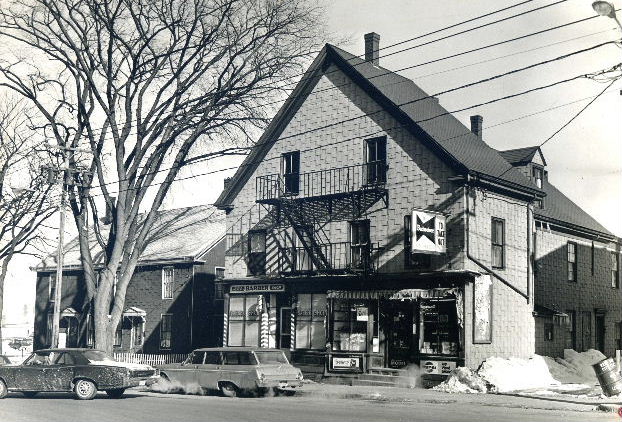
| CONNER’S MARKET aka ART’S VARIETY Photos and information supplied by Tom Clarke |
|||
|---|---|---|---|
 Emma Conner, storekeeper, 1943 |
|||
In 1935, following the death of her husband Arthur Conner, Emma Milton Conner opened Conner’s Market, a grocery store at 158 Spring Street. The store became a fixture in the neighborhood and stayed that way for the next 27 years. From 1955 (after the death of Emma) until 1962, daughter Catherine Finnerty operated Conner’s Market. She sold the store to David and Mary Mooreshead in 1962, and in a few years, they sold it to Richard Hopkins. It then became known as Hoppy’s Market. |
|||
 Conner's market, circa early 50s |
 Art's Variety, 2016 |
||
ON COMING-OF AGE ....IN 1961 |
|||
|---|---|---|---|
 Westbrook City Hall, 1960s, on the second floor of the Scates Building |
|||
If you were born around 1940 you’ll remember the biggest event in your life….your 21st birthday! On that birthday you came ‘of age’…you could drink and you could vote…you were a legal adult! Of course, at that time you were eligible to get your driver’s license at the age of 15, but the 21st far outshone that landmark. |
|||
 William Lee Clarke 1919 - 1996 |
|||
Anyone who lived in Westbrook during the second half of the 1900s will recognize the name William (or Bill, as everyone called him) Clarke. Bill was Westbrook’s City Clerk for 38 years and a figure known to most of its citizens. He was first elected to the City Council at the age of 23, in 1943, and served 6 years. He was first elected City Clerk in 1956 and was reelected for 19 consecutive terms. He saw his job as “anything a citizen wanted it to be”, and he went out of his way to serve his constituents, regardless of their political affiliations. |
|||
 |
A less formal photo of Bill as he delivers his Blue Spruce Farm Milk. | ||
| Memories of Gurney's Market by Grayson Hartley (see Photo of the Month for original item) |
||
|---|---|---|
 |
||
| A month ago the photo posted above, was added to the 'Photo of the Month page' with a piece about Cleve Gurney's Market which was supposed to be at 6 Pine Street in the 1950s. The following information was sent in by Grayson Hartley and Web Master felt it deserved a place on the People, Places, and Events page. Enjoy! Remember!! | ||
| I viewed with a great deal of interest the photo of Cleve Gurney's grocery store and the accompanying information. I grew up in the neighborhood of Seavey and Rochester streets and remember well the store and the area around it. Hoping that my memory holds true, I think the store was owned originally by Sam Watson who, as I recall, was a property owner in Cumberland Mills and lived on Lamb Street. George Watson was his brother and worked for a time in the store. As youngsters we flocked to "Sam's" for ice cream in the hot summer. Two other workers I remember besides George and Cleve, were Robert Finney, and in later years Mrs Johnson who lived on the corner of Seavey and Gray streets, She was the mother of Philip Johnson who was a native of Westbrook and worked as a radio and TV announcer on news programs for WCSH Radio and TV. The neighborhood boys, some of whom were Stanley Plummer,Daniel Lord, Alton Esty , James Hebert and your truly, and who all attended Forest Street School, had a small baseball.field in back of Gurney's store..The field bordered on the corner of Park and Rochester Streets. A good hit would often land on the side of a house on Park Street, much to the dismay of the owner, who would come out and yell at us. Gurney and Higgins Market rings a bell in my memory, but I cannot recall specifically the part Higgins played in the store other than he was a relative of Gurney and was part owner when Gurney bought the store from Sam Watson. The store was located on the corner of Seavey Street and Rochester. Pine Street was the short street that went across from Rochester to Haskell. It was just opposite the corner where Seavey met Rochester. I don't recall Kitteridge Market at 6 Pine Street. It had to be on the side street that went from the corner of Seavey and Rochester streets across to Haskell Street..By the late 1950's I had left home and was on my own |
Forest Street School Days ( 1936-1945) |
||
|---|---|---|
I write on my memories of Westbrook, notably of my 1936-1945 grade school experiences at
Forest Street school These memories are among my most vivid. They are good memories. |
||
|
| DO YOU REMEMBER? ARCHIE'S VARIETY STORE |
||
|---|---|---|
Archie’s Store on Rt. 25…It was right on the Westbrook-Gorham line. It was a very small building that set back from the street a ways. [Ed.: It was where the Baptist Church is now.] |
||
Submitted by Jim Cote, Westbrook. Jim also brought a copy of Archie Simon’s obituary of April 21, 1975. The obituary states that Mr. Simon lived at 315 Conant Street, and died April 20, 1975 after a long illness. He was born in Lewiston and educated in Portland schools.He was survived by his wife, Artiemise Locke Simon of Westbrook. He was buried in Pine Grove Cemetery, South Paris. NOTE: If you have a photo of Archie's Variety, we'd love to have a copy for our collection. |
PRESIDENT HARDING VISITS WESTBROOK - 1921
|
|||||||
|---|---|---|---|---|---|---|---|
[Portland Evening Express August 3, 1923] |
|||||||
| “OLD FAN AND THE PIANO" by Margaret Hawkes St. Pierre |
||
|---|---|---|
 "She'd come to the bottom of a hill, stop, look, sigh..." |
||
Now, stop me if you've heard this ............ . My grandmother Belle would always admonish him when he embellished the truth, so I know the horse stories to be true, as Grammy would laugh and add to Grampa's recollections. Belle Bradbury became Almon Wheeler's young bride in the early 1900's. He had lived in Cape Elizabeth at the time and would go 'a-courtin', replete with shiny horse and fancy buggy, all the way to Hollis to see her. Clean, starched, gloved and meticulously groomed himself, he softened her heart and convinced her to marry him. They eventually moved to Pride's Corner where they built their big, brown house alongside his parent's
family farm. The road was a mere 'four rods' in width when first laid out in 1783, then redefined from a "drift road"
in 1806 by being straightened and eventually paved through the years after Grampa built the house at
397 Bridgton Road .... But, like Grampa Wheeler, I digress here ... It was summertime, sultry, sunbaked and an overall clear day for the young couple to set out with plans
for a short visit with relatives. Hauling the empty buckboard over Pride Street to Rocky Hill, Fan started
out briskly, but nearing Sacarappa Falls on the Presumpscot River, her pace slowed. She'd come to the
bottom of a hill, stop, sigh, and rest a minute. No urging, prodding or flick of the buggy whip would
encourage her to walk on until she felt ready. She would wearily plod ahead when it felt right for her,
pausing halfway up the hill. She would sigh again and turn back her head to oversee Grampa engage the
brake on the empty wagon so she could lay back in the harness to fully rest her seemingly overworked
body. ... Now, let's say here that the trip home in the waning light of evening was amazingly different from the
day's crawl to Hollis ... Out of the driveway bolted Fan with the buckboard weighted down with the
piano in tow! The poor, pitiful Morgan mare who trudged a snail's pace to Hollis magically transformed
into an equine dynamo! |
||
 "Grampa leaned agonizingly back on the reins..." |
||
| Articles not tied securely down in the wagon flew out the back. There was no pausing to retrieve
anything not anchored down and left behind because that mare's one mission was HOME, NON - STOP! With a big, earth-covering trot, and what seemed in no time at all from Hollis to the far outskirts of Westbrook, Fan hit Pride's Corner and home, barely breathing hard. Her big dark eyes sparkled as she delivered the heavy buckboard, the piano, the wide-eyed Grammy and the exhausted Grampa home in record time to her own barn, supper and big drink of water! No problem to her, it was all in a good day's work. --As mentioned before, this is a true story. My Grampa told me so, many, many times. I never stopped him from telling it again, even if he asked me if I'd heard it before. I would listen intently each time, relishing in those horse and buggy days stories of my grandparents, sharing in their laughter as they carried me gently and lovingly with them to another time, another era. |
||
 379 Bridgton Rd, circa 1900 |
||
This story, and its pictures, was submitted by Margaret Hawkes St. Pierre of Falmouth. Her mother, June Wheeler Hawkes, and her aunt were born “in the front room” of the house that her grandfather built at 397 Bridgton Road, Westbrook [see Photo Archives - Apusunta Club- to read about the Webber Store at Prides Corner.] Margaret and her brother Roland also supplied information on the Apusunta Club and the Winter Fun photos. [See Photo Archives for the updates.] |
ARTHUR AND BILL CURRIER |
||
|---|---|---|
 |
||
|
For many Westbrook residents, World War II was the moment that the world opened up to them, changing them forever. Growing up in Westbrook, Arthur and Bill Currier were “very innocent and naïve,” Arthur said. “I never hardly ever left Westbrook when I was a kid. But when I got around to see people from different areas of the country…it’s an experience….It enlightens you a little bit.” |
|
| WESTBROOK STREET NAMES | ||
|---|---|---|
 Church Street |
||
It is interesting to learn how buildings, towns, streets, etc., are named; therefore, over the last few years I have collected a file on some Westbrook streets and how they got their names. During this bicentennial year, I thought it might be interesting to take a look back on this piece of our history. |
||
Note: There are always stories about name origins, so if you know of any not listed here, or dispute some of the information given here, please contact info@westbrookhistoricalsociety.org |
| WESTBROOK 200 - OPENING THE CAPSULE | ||
|---|---|---|
 |
||
|
Captured in 1958 by Portland newspaper staff photographer Olson, Edward Murray, James Allard and Stephen Bragdon sit looking at the Riverbank Park monument which is scheduled to be opened in June of this year. The park was dedicated in 1914 and a large boulder was brought from Rocky Hill to become a monument to Westbrook's centennial celebration. The monument's inscription reads: "This stone contains records of the 100th anniversary of the City of Westbrook, occurring June 9th, 1914. This stone is to be opened and records read at the 200th anniversary June 9th, 2014. Erected by the Board of Trade." The four day centennial celebration featured what was believed to be the longest parade ever organized in the state at that time (1,000 military men) and the biggest fireworks display up until that time. The capsule is supposed to contain newspapers, photographs and Westbrook statistics. Make plans to be at the opening in June! |
|
| WESTBROOK, TWO-HUNDRED YEARS YOUNG by Ted Lampron (a 2013 History Contest entry) |
||
|---|---|---|
 |
||
For each generation that passes before us, a new time capsule of memories is created, and for those who look back on those memories, they may be reminded of the best years of their lives. Blessed is a generation that can truly appreciate their heritage, and now that the Westbrook Bicentennial is before us, we open the gate to a time capsule that dates back two hundred years. How does one encapsulate or capture the significance of the past two hundred years is beyond my ability. I cannot speak for the early colonist, who, with Colonel Thomas Westbrook, incorporated Westbrook as Stroudwater on February 14, 1814, and I cannot describe the life and times of those people who held dear to their hearts the building of Westbrook from one generation to the next. But what I can tell you, is that my past memories of Westbrook are a state of mind, an illusion brought about by fond memories of my youth. A vortex of thoughts that swirl around in a nostalgic whirlpool of days gone by. |
||
What more fitting article for this page than this one taken from the Westbrook High School year book, The Blue & White, 1955.] |
||
|---|---|---|
Down through the years from the time Westbrook High School was established, it has been progressing in education and expanding in size. |
||
In 1883, the first public graduation was held by Westbrook High at a Congregational Church. There were three graduates: Lotta May Woodman, Eleanor Murch, and Hattie Hamblin. Around the turn of the century, the school day began at 8:00 and came to an end at 12:00. Such pranks, as are played today, were played then. Boys rolled "shot" down the aisle letting it hit against the wall making a noise which disturbed the class. They chewed on their tongues to attract the attention of the teachers who would ask what they were chewing on. They would then stick out their tongues. |
| THE DIRENZO FAMILY by daughter Shirley DiRenzo Cleveland (A 2013 History Contest Entry) |
||
|---|---|---|
Assunta DiFiore came to the United States with her mother Antoinette DiFiore and her two siblings after her father Dominic died at the age of 24 in their hometown of Adano, Italy. At the time of her immigration she was approximately 8 years old, her brother Alfred was about 9 and her sister Minnie about 7 years old. After coming to Portland, relatives matched Antoinette up with the much older Rosario Mancini, father of four grown children. They married and lived near Adams and Newberry Streets. |
||
I remember moving to Westbrook when I was in the second grade at the Warren Elementary School, one of 13 children of Antonio and Assunta DiRenzo, immigrants from Italy. She was quite a lady who went by the name of Ma, Grammy, and Mrs. DiRenzo to who knew her. A mother whose children will never forget and a father who loved us all unconditionally. |
||
|
||
Top of the S.D. Warren Chimney -
October 1979
|
|||
|
|||
Burt Bittner and I were asked to measure the temperature of the exhaust from the Warren chimney. It was just another interesting day at work on the job for us and we didn't think much about the climb of the 360- foot plus Warren stack. To measure the correct temperature of the exhaust at the top, it would require reaching into the center to avoid any edge effect. We used two long pieces of 3/8-inch pipe extended towards center of the chimney with thermocouple-measuring wires attached Thermocouple wire consists of two different kinds of metal welded together at the end, which produces an electric current. These wires would extend to ground level, the electrical current measured and converted to find the temperature. Days before, we prepared the wires with a special coating to protect them from the weather.
A crew was doing maintenance on the chimney and had installed a platform around the top. with a hoist to bring up material. The hoist consisted of the steel cable with about an 18-inch iron ball at the end holding it straight in the wind. The View: The Final Results: |
|||
CUMBERLAND MILLS BARBER SHOPS |
|||
|
|||
There was no shortage of barber shops in Cumberland Mills during the 30's and 40's. I recall growing up in Westbrook during that period of time: Stevie's Barber Shop, Earl Stanley's [pictured here; see below. Ed.], Ben Crowley's, Vincent Bruno's and for a short time, Willis Strout's. |
|||
Thanks to Mike Sanphy for the above photo to accompany this essay, and for the following supplemental information: The Barber Shop seenon the left of the larger building (7 Cumberland Street) was operated for many years by Earl Stanley. When Mr. Stanley passed away his wife Mildred took over the Barber Shop and operated it until the building was sold. Mr. & Mrs. Stanley resided at 511 Bridge Street, present site of Rocky Hill Manor Nursing Home. |
|||
| REMEMBERING BROWN STREET 1930s to 1940s Written by Philip LaViolet (1924 - 2009) [This article and accompying map was done by Phil LaViolet quite a few years ago "so people of Westbrook will remember what Brown Street used to be like when I was young." Copied,as much as possible, as he originally hand-wrote the material.] |
||
|---|---|---|
S.D. Warren Houses at one end |
||
 |
||
WHEN I WAS YOUNG...(in Westbrook) |
 Rhoda M. Daley WHS 1943 "To be awake is to be alive" |
When I was young we walked everywhere. There was very few cars on the road. The winter snow made it hard to drive. There were no plows. It was all done by hand. |
|---|---|
Back then the church bells filled the air. And Dana Warp mill whistle sounded at noon, 3:30 PM and at 9PM. On Thursday and Saturday the stores were open until 9PM. All the stores closed for the weekend. ******************************************************************************************** |
|
This all started in the early 1920s Rhoda Leroux 86 years old 2012 |
|
THE ALBERTS OF WESTBROOK |
The Albert's of Westbrook have two distinct legacies: one related to the industrial history of the city and one related to a once-thriving and revered local business. Before these legacies came about in Westbrook, the Albert ancestors raised their families in Canada, and earlier in France.
The photo to the right shows many Albert descendents at a 2010 family gathering in Westbrook, Maine.
|
 |
Ferdinand's year of immigration was reported as 1887. ** See photo and more information on Haskell Silk Mill on the 'Photo Archives' page |
|
|
| The business legacy of the Albert family began when Ferdinand’s son, Auguste, found his life’s calling in the art of salesmanship at a very young age. The early death of his mother caused him to be resourceful by finding work helping local businesses. One of those businesses was the clothing store called A.H. Benoit & Co. His experience working at Benoit's, and the contacts he made from working there, led to the formation of his own clothing business that became known as The Men's Shop, Inc. |  |
| The Men's Shop ad (above) was taken from the 1924-1925 Directory of Westbrook, Gorham and Windham, p. 206. | |
 |
Auguste Albert (1900-1982), known as "Gus", developed a reputation as a devoted astute businessman, and was much respected and loved by his family and loyal customers. He inspired this writer to create a blog on the genealogy of the Albert's called August Legacy (augustlegacy.blogspot.com).
|
|
Our immigrant ancestor from Europe, Gabriel Albert (c.1738-1795), emigrated from Normandy, France, to the town of Pabos (Gaspe region of Canada) to work as a fisherman. Well before Jamestown and Plymouth Rock, French fishermen were reaping the benefits of the abundant fishing grounds off the Grand Banks of Newfoundland and the Gulf of St. Lawrence. Pabos became an important fishing harbor. Gabriel married Genevieve Le Bouthillier in 1751.***
|
|
|
|
As a result of a northern campaign in the French and Indian War, British forces burned Pabos in 1758 causing settlers to scatter. To ascertain the whereabouts of the Acadian population after their tragic 1755 expulsion, an official from Montreal, Pierre duCalvet, went to the Gaspe Peninsula in 1761 to conduct a census. Although not Acadian, Gabriel Albert (and his wife and first son) were among the counted, and found to be living on Caraquet Island. In the Royal Proclamation of 1763, the Albert family moved to the mainland. They were among a group of families allowed to settle on uninhabited land in Caraquet proper. Later and more famously, Gabriel and his first son, Pierre, received 400 acres of land through a royal decree in the "Great Grant of 1784". The grant brought ownership of the lands they were settling on. Thirty-two other families also received land grants, and these folks became known as the Founding Families of Caraquet. The government of Nova Scotia administered the grants because New Brunswick had not yet become a province. |
|
The diagram below shows the Albert genealogy from Gabriel Albert to the children of Auguste Albert. Jean-Baptiste Albert (c.1760-1830) was Gabriel's second son. |

|
THE LABRECQUE FAMILY'S CANADIAN LINE |
||
Anna Rose de Lima Labrecque was born to Regis and Sarah Ann (Witty) Labrecque in Canada in 1883. She and her family immigrated to Westbrook, ME in 1892. There were thirteen children in the Labrecque family. Anna's grandson Michel Giguére of Quebec City writes that he has some interesting photos of Anna and her family and of Anna working at the Blue Bell and teaching at the elementary school in Westbrook (see photo below; also see the Photo of the Month page.) |
||

In 1912 Anna married married Conroy Giguére in Westbrook and returned with him to Quebec City where they raised their family. She left ten of her brothers and sisters behind in the States. In seeking information about Anna we were surprised, and pleased, to discover that she was the sister of Joseph Labrecque, whose article appears below. Anna's grandson is now seeking photos of Anna's wedding, family and friends in Westbrook. If you have any information, please contact the Westbrook Historical Society at: |
||
|
|
|
Leanne Hudson of Stamford, CT wrote to us recently about her great grandparents Joseph E. and Eugenie (St. Pierre) LaBrecque. Joe was one of 13 children of a Westbrook family. He and Eugenie were married in 1933 when Eugenie was 45 and Joseph was 36. (Their wedding picture is seen here). Around 1945 they moved to a home beside the Stroudwater River, at 546 Spring Street, where they would live for the next 30 years. Eugenie was an artist and the river became an inspiration for some of her paintings. Leanne sent a copy of one of Eugenie’s paintings which appears to be of the old Johnson’s Mill which sat on the river, in line with Brackett Street, around the turn of the century. Leanne’s mother told her that years ago Warren Memorial Library exhibited Eugenie's artwork. Joe was also an ‘artist’ but his projects were created in his workshop where his great grandchildren spent many an hour watching over him as he made everything from whirly gigs to glider swings. And, as Eugenie signed her paintings, Joe burned his signature into a wall in his shop. Leanne states that Joe was a wonderful unique human being…a true one of a kind. She called him “Beautiful Joe” as in the vintage storybook that was given to her by Eugenie. Leanne still has that book and it is dated late 1800s in pencil on the inside cover which tells her that her grandmother had it as a child as well. |
 |
|
Leanne remembers that Joe and Eugenie attended St. Hyacinth's church every Sunday, most times with her and her brother in tow. “They were very devout Catholics. Back then men wore hats to church and clipped them in the hat clips on the back of the pews, women wore mantillas and fully garbed nuns were in abundance...” Leanne also writes: I was very fortunate to live next door [to her grandparents] at 544 Spring for 10 years and had an extremely close relationship with my Grammy and Joe…. I played in that river from the Spring Street end all the way up into the woods towards Saco Street. My childhood friend, Judy Willette and I took a homemade wooden raft down the river from Spring Street all the way to Portland!! We had to carry along the bank at some points but what an adventure! We ended up calling from a pay phone for a ride home and our parents were in shock. I ended up with a good case of poison oak as a result but would do it again tomorrow if I could. What a great childhood I had working on Clarke's dairy farm, riding horses, bringing in the cows, hay baling was a huge adventure as we all rode on top of the bales behind the tractor down Spring Street after a long day in the fields. I was trampled by feisty cows and horses once and Mrs. Clarke had me on the concrete floor of the milk room hosing me down to wash the blood off. I have the scars to prove it! I even helped Mr. Clarke deliver a calf one day. What a great childhood... I attended the junior high on Main Street which I understand is apartments now. I remember going up in the annex for chorus and feeling like we were going to fall through the floor! ….I miss those times very much. I was born in 1958 to give you an idea of the timeframe I am talking about. Clarke's farm is still there, my best friend still lives on Spring Street and her parents’ home is still there (now Ed's Batteries) |
|
Leanne’s parents are Bob Hudson and. Carol Ann Cass. “My father grew up on Tolman Street and also came from a large family. He owned Hudson's Floor Covering on Route 302 in South Raymond for many years but has retired to Florida. I miss the old days up at our camp on Panther Pond too. What a great life between Westbrook and the lake - only 30 minutes apart. I wish so much that my son could have had the childhood I did. The world has changed so much unfortunately. [Eugenie LaBrecque's painting of the Stroudwater River] |
 |
|
You may also check an on-line genealogy of the Labrecque family which contains many Westbrook connections, including the family of Joseph E. LaBrecque: http://familytreemaker.genealogy.com/users/l/a/b/William-A-Labrecque/PDFBOOK1.pdf |
. |
©
2006 Westbrook Historical Society, 426 Bridge Street, Westbrook, Maine 04092 • (207) 854-5588 |
.jpg)


 [History of Assunta and Antonio DiRenzo seen below was supplied by their youngest daughter Rose DiRenzo Prillaman of Newport News, Virginia. This was inserted to give a background setting for her sister Shirley's family story.Thanks also go to Rose for the pictures of her family.]